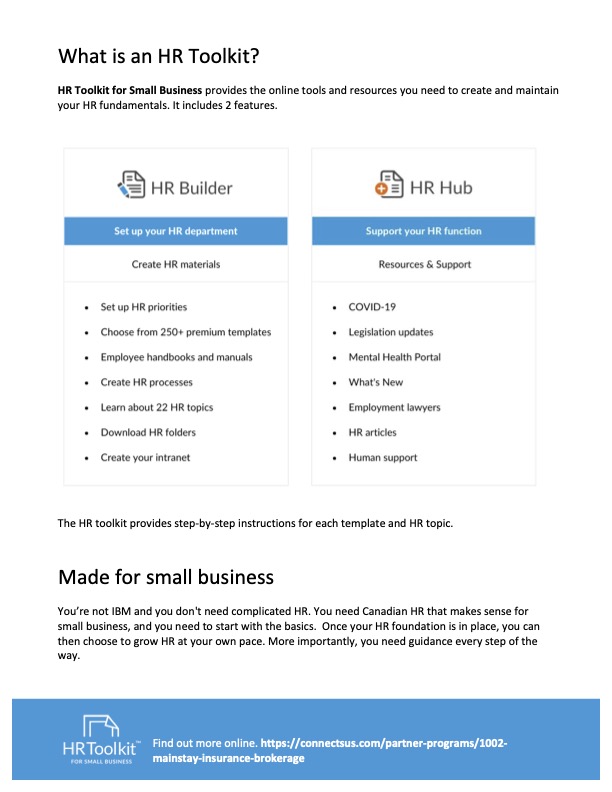
If you’re a Mainstay client, you have access to our free HR Resources. If you’re already signed up, great, they just got better (see below). If you haven’t yet, please reach out and we’ll give you a discount code to get you set up.

If you’re a Mainstay client, you have access to our free HR Resources. If you’re already signed up, great, they just got better (see below). If you haven’t yet, please reach out and we’ll give you a discount code to get you set up.

If you’re an employer with over 25 employees, you’ll want to read this short article as you need a written policy in place by October 2022.
If you’re a Mainstay client, we have provided HR resources that include a sample policy you can adopt to your firm. If you’re not signed up yet, reach out and I’ll give you the code to access the info, which includes complete employee handbook, policy samples and templates.
In the spring, Bill 88, Working for Workers Act, 2022, received Royal Assent and became law. Among other things, Bill 88 amended Ontario’s Employment Standards Act, 2000 (ESA) to require certain employers to ensure, within a specific time frame, that they have a written policy in place for all employees with respect to electronic monitoring of employees (Policy).
On July 13, 2022, in its Your guide to the Employment Standards Act, the Government of Ontario published employer guidance for complying with the Policy. In this Insight, we provide a summary of that guidance in Q & A format.
The Ontario government has extended the IDEL to march 31, 2023.
The post from e2r below provides more information.
If you thought COVID-19 was over, think again.
The majority of our clients are Canadian companies based in Ontario. Some have employees in other provinces and occasionally in the US or abroad. In other cases, the head office is in the US or Europe, and they have smaller offices located here, in Canada, that often represent a small portion of their employees.
For the cases of US employers with Canadian employees, I occasionally provide articles of interest in understanding how our systems are different when it comes to benefits, HR and employment law. this article references a great 48 page book you can obtain (or download).
On June 28, 2022 the McCarthy Tetrault’s Labour and Employment Group, along with leading partners from other practice areas in the Firm, hosted an insightful webinar on key cross-border topics and trends for business. The webinar coincided with the launch of our Cross-Border – Navigating Canadian Employment Law Guidebook.. The following are some highlights from the panelists:.
As a Mainstay client, we provide FREE HR resources for your firm.
If you’re already signed up, GREAT!. This is a reminder that the services are there for you to use.
If you are not signed up, there is more information below and on our site at https://connectsus.com/partner-programs/1002-mainstay-insurance-brokerage, or give us a call.

If you have Ontario employees, please read this article for the required postings each office must have. The link provides a list of all you need to know as well as; posters, sources for documents etc. in order to stay in compliance.
Employers subject to provincial legislation (i.e., not federal employers) that have employees in Ontario often ask about legislative requirements under various employment statutes, including mandatory policies, training, postings, and information sheets under the Employment Standards Act, 2000, the Workplace Safety and Insurance Act, 1997, the Occupational Health and Safety Act, the Accessibility for Ontarians with Disabilities Act, 2005, the Pay Equity Act, the Smoke-Free Ontario Act, 2017, the Working for Workers Act, 2021, and the Working for Workers Act, 2022. To make this information conveniently available, the Littler Toronto office assembled these requirements in a single publication.
We have prepared an update to this publication dated June 20, 2022 (11th edition), which includes new information about the policy on disconnecting from work and information on the new policy on electronic monitoring of employees, which are mandatory for most employers. This edition of the publication also reflects the elimination of COVID-19 restrictions, with the exception of a masking requirement in long-term care and retirement homes. Click here to read the June 2022 update.

A quick to read article on changes affecting Ontario employers.
On Monday, April 11, 2022 Bill 88, the Working for Workers Act, 2022 (the “Act“) received Royal Assent and came into force. The Act is intended to be a part of the Ontario governments continued response to the recommendations contained in a report from the Ontario Workforce Advisory Committee. Previously the government passed Bill 27, Working for Workers Act, 2021 which requires employers with 25 or more employees to implement a right to disconnect policy by June 2, 2022. This Act, like its predecessor, makes several notable changes to the workplace through the creation and modification of legislation.
With the Ontario Provincial Election just around the corner, now is a good time to start thinking about your obligations as an employer to provide your employees with time off work to vote.
Clients and prospects often consult with us to learn where benefit costs are going from year to year. We publish average increase on our website HERE and include the highs and lows in our April newsletter each year also available on our site HERE.
It has been certainly tougher to predict, during the past 2 years, with COVID changing treatment habits (dental and parameds especially) and the higher than average increases in both use and charges we’ve seen in some sectors. Dental has seen a 4.75% increase in the ODS fee guide and when trend and utilization is added to that inflation, we are seeing costs rise about 6%. This report below is indicating that drug costs are not that high, which coincides with what we’ve seen of about 5% a year over the past 10 years or so.
While the overall private drug plan spend per member increased by 4.3 per cent in 2021, fewer plan members submitted claims and the per-claimant cost grew, according to Express Scripts Canada’s latest prescription drug trends report.
I share legal cases that I think may apply to our clients (small and mid-sized firms), or areas they should be aware of. Many of these are the extremes (rather than norms) of what happens when termination go wrong, for example, and illustrate the risks employers may face. This article is more employer friendly and I especially like the commentary where they say… “These decisions represent a major win for employers in Ontario. There is a commonly held belief that terminating a short-service, advanced-aged employee without an enforceable termination clause is akin to setting oneself on fire, when taking into consideration the perceived risk associated with combination of these outlier factors.”
A recent pair of Ontario Superior Court decisions offered interesting insight on the determination of reasonable notice when faced with widely considered “outlier” factors. The two decisions, Flack v. Whiteoak Ford Lincoln Sales Limited (“Flack”) and Ewach v. Whiteoak Ford Lincoln Sales Limited (“Ewach”), were presented back-to-back to Justice S.F. Dunphy and involved the same employer and employees in similar circumstances.