Updated Guidance On How Employers Should Fill Out Records Of Employment During COVID-19 Pandemic

If you are wondering how to code Records of Employment forms (ROE’s) in this “COVID” era, take a quick read of this short article below…


The Record of Employment (ROE) (Block 16) provides information on an employee’s employment history when they apply for Employment Insurance (EI) benefits.  The information on an ROE is used by Service Canada to determine the employee’s eligibility to receive EI benefits, the benefit amount, and how long the benefits will be paid.  Employers must issue an ROE each time an employee experiences an interruption of earnings. Canada provides a guide on How to Complete the ROE form.

READ THE ARTICLE HERE

Ontario to propose ‘right-to-disconnect’ laws

I’m not so sure that Ontario employers need any more legislation, but those with over 25 staff could be required to implement “right to disconnect” standards in the very near future.  Take a read of the article below for more information.


Ontario employers will soon be required to create right-to-disconnect policies for their workplaces, in an effort to address the ills of “hyper-connectivity.”

Legislation expected to be introduced this week will, if passed, require workplaces with more than 25 employees to develop internal right-to-disconnect standards. The move would make Ontario the first province in Canada to implement such a measure.

https://www.thestar.com/news/gta/2021/10/25/buried-in-after-hours-emails-ontario-to-propose-right-to-disconnect-laws.html

Updates to minimum wage rates across Canada

Although the majority of Mainstay clients pay well in excess of minimum wage, I thought it important to share these changes…


Employers in Ontario, Manitoba, Newfoundland & Labrador and Saskatchewan, will be required to comply with the new increased minimum wage effective October 1, 2021.

Effective October 1, 2021, the general minimum wage in Ontario increased to $14.35 per hour. Under the Making Ontario Open for Business Act this increase is tied to the Ontario Consumer Price Index for 2020.

Similar to Ontario, Saskatchewan’s minimum wage is calculated using an indexation formula. Accordingly, effective October 1, 2021, the minimum wage in Saskatchewan increased to $11.81 per hour.

Manitoba’s minimum wage has also increased. As of October 1, 2021, the minimum wage in Manitoba increased to $11.95 per hour.

Finally, on October 1, 2021, Newfoundland and Labrador introduced its second of two wage increases for 2021. Accordingly, minimum wage in this province is now $12.75 per hour.

Below is a reminder of the general minimum wage rates across Canada.
British Columbia: $15.20 effective June 1, 2021
Alberta: $15.00 effective October 1, 2018
Saskatchewan: $11.81 effective October 1, 2021
Manitoba: $11.95 effective October 1, 2021
Ontario: $14.35 effective October 1, 2021
Quebec: $13.50 effective May 1, 2021
New Brunswick: $11.75 effective April 1, 2021
Nova Scotia: $12.95 effective April 1, 2021
Prince Edward Island: $13.00 effective April 1, 2021
Newfoundland and Labrador: $12.75 effective October 1, 2021
Northwest Territories: $15.20 effective September 1, 2021
Yukon: $15.20 effective August 1, 2021
Nunavut: $16.00 effective April 1, 2020

READ THE POST

ALL EMPLOYERS SHOULD READ – OHRC statement on COVID-19 vaccine mandates…

The Ontario Human Rights Commission (OHRC)  has released a statement on covid-19 vaccine mandates and vaccine certificates.

The statement is helpful for employers and provides guidance on potential for non-medical code accommodations.

The OHRC confirmed requiring proof of vaccination to protect people at work is generally permissible under the Human Rights Code (“Code”):

“While receiving a COVID-19 vaccine remains voluntary, the OHRC takes the position that mandating and requiring proof of vaccination to protect people at work or when receiving services is generally permissible under the Human Rights Code (Code) as long as protections are put in place to make sure people who are unable to be vaccinated for Code-related reasons are reasonably accommodated. This applies to all organizations.

With respect to non-medical accommodations, the OHRC confirmed a personal belief will not be covered by the Code:

The OHRC and relevant human rights laws recognize the importance of balancing people’s right to non-discrimination and civil liberties with public health and safety, including the need to address evidence-based risks associated with COVID-19.

Receiving a COVID-19 vaccine is voluntary. At the same time, the OHRC’s position is that a person who chooses not to be vaccinated based on personal preference does not have the right to accommodation under the Code. The OHRC is not aware of any tribunal or court decision that found a singular belief against vaccinations or masks amounted to a creed within the meaning of the Code.

While the Code prohibits discrimination based on creed, personal preferences or singular beliefs do not amount to a creed for the purposes of the Code.”

Please see the attached link below for the full statement:

http://www.ohrc.on.ca/en/news_centre/ohrc-policy-statement-covid-19-vaccine-mandates-and-proof-vaccine-certificates

EMPLOYER WEBINAR – COVID-19: Returning to Work During the 4th Wave in Ontario

We have had several clients reach out wondering about the return to office, vaccination policies, exemptions, accommodations etc.

This seminar below may be of help, but you need to register this week by Monday, September 27, 2021


COVID-19: Returning to Work During the 4th Wave in Ontario

We are pleased to invite you to an upcoming webinar with Blaneys’ Employment Lawyers, Christopher McClelland and Jack Siegel on September 28, 2021 at 12:00 PM EDT. 

As Ontario continues to reopen and with virtually all employees eligible for COVID-19 vaccines, many employers are moving forward with a gradual return to the workplace. What guidelines do employers need to follow as part of their reopening plans? 

Join us for a discussion about: 

  • Vaccination policies: What should be included? Can employers insist on employee vaccination?
  • The latest on public health measures and health & safety protocols
  • Ending, modifying or maintain alternate work arrangements (remote / hybrid)
  • Accommodating a returning workforce
  • Supporting employees in navigating and enforcing vaccination requirements

This session will end with a Q&A where we will try to answer as many of your questions as possible.

This webinar is complimentary and open to you and your colleagues. We hope you can join us!

To register please click here.

Ontario Releasing Guidance to Support Proof of Vaccination Policy

COVID Vaccination information you may find useful.


As the province continues to respond to the fourth wave of the pandemic driven by the highly transmissible Delta variant, the government is further protecting Ontarians through continued actions that encourage every eligible person to get vaccinated and help stop the spread of COVID-19.

Today the government released the regulations and guidance for businesses and organizations to support them in implementing proof of vaccination requirements, which take effect on September 22, 2021. Requiring proof of vaccination will help increase vaccination rates, protect individuals in higher-risk indoor settings, and keep businesses open.

https://news.ontario.ca/en/release/1000807/ontario-releasing-guidance-to-support-proof-of-vaccination-policy

COVID-19 Vaccination Education Module

We’ve had several clients looking for educational resources around COVID-19 vaccination.  The following info is provided by the City Of Toronto and provides a certificate after completion.


COVID-19 Vaccination Education Module

Workplace policies should require workers who do not provide proof of vaccination to complete a vaccination education module with a signed declaration that they understand the risks of COVID-19 and the benefits of vaccination. Employers can use Toronto Public Health’s COVID-19 Vaccination: Understanding the Benefits and Risks module for this purpose.

https://www.toronto.ca/ext/digital_comm/tph/covid-19-vaccination-understanding-the-benefits-and-risks/story.html

Ontario’s Enhanced COVID-19 Vaccine Certificate

Things are changing in Ontario, and the governments announcement yesterday (September 1st) includes Mandatory vaccinations for many public spaces (seminars, concerts, restaurants etc.).

This document is NOT intended as a workplace resource, but does provide a window into what Ontario residents are going to have to do to attend events, travel etc. and will likely play a part Ontario Vaccine cover to increase vaccination rates.

Please click on the image or link below to see the whole document.


https://mainstayinsurance.ca/mainlinkimages/Ontario%20Vaccine%20Certificate%20Program%20Background.pdf

Free HR/legal Webinar on Vaccination, Testing, Return to Work (9/30/2021)

Employers are always looking for HR advice around tricky issues and Laura Williams and her firm are great at sharing through events like the one below.  We help sponsor some events (through the association I run – CGIB.ca) and share others, like this one, that may be of interest.  Please feel free to register for those that are of interest through the links below.  They are free of charge, and how often do you hear lawyers and free in the same sentence? 🙂


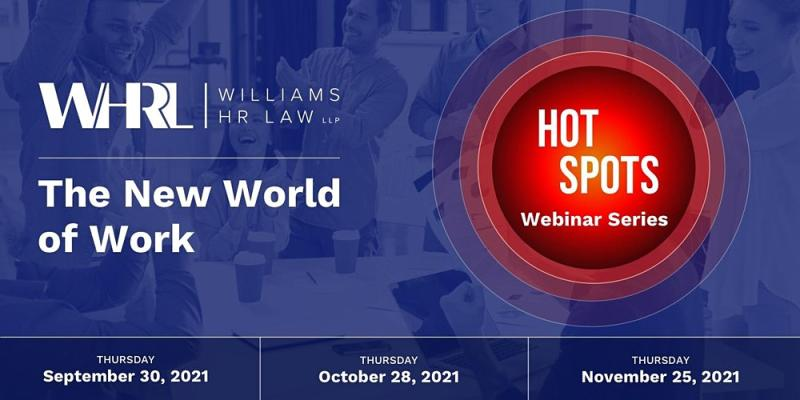
This fall, due to popular demand, the Williams HR Law team will be putting on a series of three free one-hour webinars, focusing on “hot spots” that we have identified as the most challenging and particularly pressing for employers as they navigate “The New World of Work”.

Register here to join us from 12-1 pm on September 30, October 28 and November 25!

The first webinar, on September 30, focuses on the “hottest topic” in HR law today: COVID-19 vaccination and testing policies. While the general strategies we will discuss during the webinar will help all employers, we recognize that many organizations require customized guidance and support with their efforts to develop return-to-work and vaccination strategies and policy development. We are currently supporting many of our clients with those efforts and would be pleased to support your organization as well. Please reach out to one of our lawyers for assistance.

Exclusive Client Benefit – FREE ACCESS to Canadian HR & COVID Toolkit

Dear Mainstay Clients,

We periodically remind our clients that Mainstay has entered into a program with ConnectsUs HR ™ to provide HR Resources.  We currently have about one third of our clients using the the site. If you have not yet checked it out, please do so HERE

Your free access to the proven HR & COVID-19 toolkit lets you:

  • Stay on top of the pandemic as it relates to your workforce with the COVID-19 Portal, notifications about important announcements, resources & templates.
  • Gain continued access to pre-written templates and legislated updates, including jurisdiction-specific Employee Handbook updates for 5 provinces.
  • Explore the latest and greatest content that’s continually added, including the most popular HR kits with detailed instructions: 

Effective August 27, 2021, all basic employee handbooks and comprehensive employee manuals now include a COVID-19 Mandatory Vaccination Policy template. 

The new policy is located in each of the 10 documents in the Staff Policies section under Conditions of your Engagement.  You can find the documents in the Employee Handbook Kit.

The best part?  There’s no cost to you – we’ve picked up the tab and you won’t even have to provide a credit card. Just drop us a note and we’ll give you a code to access the resources for free.