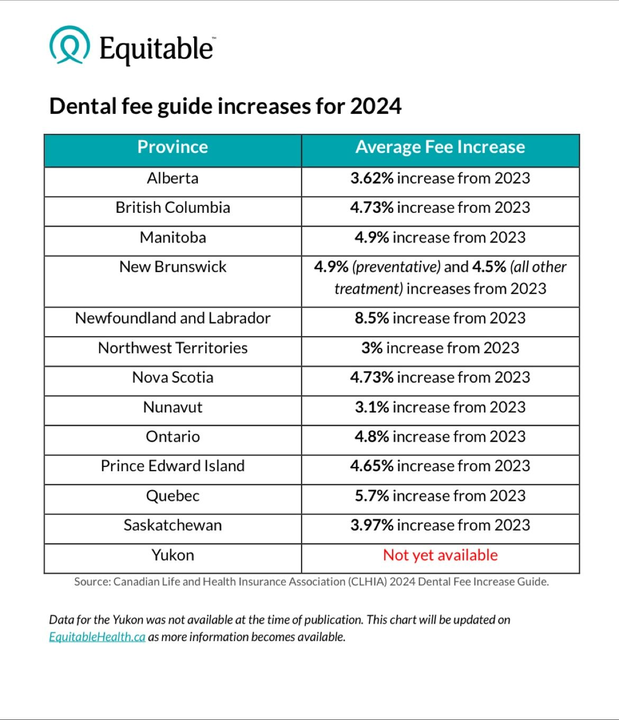
Dental Fee guides out for the country…

Each year the provincial dental associations release their fee guide adjustments (see 2024 below).  Last year Ontario saw the largest increase in 25 years at an 8.5% increase.  Things have settled for 2024 at 4.8% but still the second highest I can recall in my nearly 28 years in the industry.  This is also more than double the annual trend we’d seen over the decades.

The fee guide increase is what drives the inflationary portion of claim costs.  This means that if your employees paid $100 for a service last year, the same service will cost $104.80 this year (on average – some codes are higher and others lower).  On top of that we also have trends and utilization that increase the final cost.  These are the effect we see over time for patients going into the dental office more often (like cleanings ever 3 months instead of 6) and for more things (like scaling units).  All put together we may see overall average increases of 7.5%.


Drug Access Navigators (DANs) take key financial stress away from patients

In the past, we’ve shared information about healthcare navigators (like Ray Rupert below).  Navigation experts can help with complicated health issues and assist in gaining access and resolving situations by acting as your advocate.

Raymond Rupert  – RCM Health Consultancy Inc.  – 647 350 5500 ext 105  –  rrupert@rcmhealth.ca –   www.rcmhealth.ca 

Navigators are often used in speciality clinics to help obtain access and funding for high cost speciality drugs, and used to access testing and services as well as second opinions.  The article below shares how they may also be used when it comes to cancer treatment.


Drug Access Navigators help people with cancer get financial support for treatment and almost every cancer clinic in Canada has one.

Drug Access Navigators (DANs) or Medication Reimbursement Specialists (among other similar titles) are a critical part of the healthcare team, helping connect patients with cancer with financial support for their medications.
This means assisting them with applying for approval from a private drug plan or making an application to a government program; getting authorization from the provincial or federal government for a medication; or filling in the financial gaps where private or public plans don’t fully cover a drug’s cost.
 

What do Ontario employers need to know ahead of new pay transparency legislation?

This legislation would require employers to include salary ranges in ALL job postings.  What this means is that both new job candidates (and existing employees) will see the salary range offered and will be in a better position to make informed decisions, before taking a job (or negotiating increases).

The article below has a quote that clients may want to keep in mind about highlighting perks (like their benefit plans) when doing postings.

“Smaller companies that don’t have well-structured compensation policies and practices will be most impacted by the legislation. In order to attract and retain skilled professionals, these companies will need to quickly establish defined compensation processes and may also have to go the extra mile and include other aspects of the compensation and benefits package, including perks, in job postings.”


Before new pay transparency legislation takes effect in Ontario, it’s important for employers to ensure their current compensation structure is in order…  READ ARTICLE BELOW

https://www.benefitscanada.com/human-resources/hr-communication/what-do-ontario-employers-need-to-know-ahead-of-new-pay-transparency-legislation/

2023 HR Law Year in Review & Trends to Watch in 2024 – Webinar January 30th

Each year Williams HR Law LLP does a great summary on what to “be on the look out for” in the year ahead around Employment Law and HR issues.  Details are below.  Hold the date and watch for more

Keep an eye out for registration information for the webinar, which will be shared in early January. 


Organizations across Canada are continuously challenged to stay ahead in the world of HR Law. From the challenges associated with remote work, nuanced terminations, and legislative updates to matters of bad faith conduct, accommodations and independent contractor relationships, it is difficult to stay afloat, let alone be proactive in navigating the numerous changes that have emerged in 2023.

To keep you and your organization In the Know, Laura Williams and the Williams HR Law team invite you to our annual, complimentary 2023 HR Law Year in Review & Trends to Watch in 2024 webinar on January 30, 2024, from 12:00 pm – 1:30 pm

Save the Date

Topics that will be covered in this Year in Review webinar will include:

  • Remote work challenges, such as time theft and moonlighting, including strategies to foster successful remote work arrangements
  • The latest shifts in the law on the enforceability of termination clauses and the assessment of reasonable notice
  • The expanded scope of bad faith conduct, including best practices to avoid liability for moral and punitive damages
  • Key developments related to accommodations, including compliance strategies for mask and vaccination policies
  • New WSIB reporting requirements and case law
  • Legal developments related to fixed-term independent contractor agreements, and best practices for organizations to mitigate risk
  • Critical considerations when assessing credibility and reliability in workplace investigations
  • Legislative updates affecting Ontario and federally regulated employers, including pay transparency and notice of termination requirementsThis interactive webinar will include Q&A time for attendees to pose questions which Williams HR Law’s lawyers will answer live.

Canada is rolling out its dental care program. Here’s what you need to know

There is still a lot to be announced about the upcoming Federal Dental program (hint: Don’t expect too much), but in the meantime, these articles are proving some of the details people have been waiting for on the implementation.

Toronto Star Article

CP24 Article.

Our past blog posts also provide details on coding T-4’s

Any questions?  Just reach out and we’ll try and help.

HR Resources updated for Mainstay Client Partners

As a Mainstay Insurance client/partner we have obtained free HR resources for your firm.  Many of you have already subscribed, and use the templates and documents to help set up policies, or to be prepared before speaking to an employment lawyer (saves time and money!)
 

Now there is a New Updated Version with Important changes to the Employment Agreement Template

  • The Employment Agreement Template has been revised to include the following changes:Additional language to protect your business against force majeure or unforeseen circumstances such as a pandemic.
  • General language and consistency edits throughout the document.

If you’re already subscribed, log on to the RESOURCE CENTRE and follow the banner.  If not, please read below.


Clients often tell us that you need HR, that you don’t know where to start, who to call, what to do.  And too often, end up do nothing.

You’ve been heard!  Mainstay has entered into a program with ConnectsUs HR ™ so you can take advantage of the proven HR package made for Canadian small business and compliant for Ontario, Alberta and BC.

The best part?  There’s no cost to you – we’ve picked up the tab! You won’t even have to provide a credit card.

Simply ask us for a 100% FREE discount code and follow the link below.

Click here  to find out more and get started on your HR today! 

988 hotline for those facing mental health crisis launches across Canada

This is a great new service…spread the word.


Similar to 911, 3 digits will connect people to suicide prevention services quickly

Canada’s 988 hotline, which gives people access to suicide prevention services via call or text, went live on Thursday.

People in every province and territory who are experiencing a mental health crisis and need immediate, real-time support can use the three-digit number.

Similar to 911 for accessing fire, police and medical emergencies, 988: Suicide Crisis Helpline is a short, easy-to-remember number to get a quick response from coast to coast to coast, 24/7 and free of charge.

READ MORE

Ontario Legislative Updates

This is a summary of the Ontario changes passed or pending that may affect clients.  The info is provided by e2r HR/Law


Further to our last Alert, here are some additional legislative updates that employers should be aware of.

Working For Workers, 2023

On October 26, 2023 the Working for Workers Act, 2023 received Royal Assent and is now in force. Among a whole slew of changes the following are the most notable:

  • Mass Terminations – Remote workers, along with in-office workers, are now to be included when calculating whether an employer meets the threshold of 50 or more employees being terminated. If this threshold is met during a 4-week period, mass termination requirements are triggered.
  • Increased Fines – The Ontario Health and Safety Act has been amended to allow for maximum fines to be increased from $1,500,000 to $2,000,000.
  • Information for New Hires – The Act allows regulations to be introduced that could require Ontario employers to provide current and prospective employees with written information on their position. No specific regulations have been released as of yet.
  • Licenses for Recruiters and Temporary Help Agencies – Temporary help agencies must have a licence to operate, and recruiters must have a licence to act as a recruiter as of July 1, 2024. This does not include employees performing recruiting’s functions as a duty of their position within an organization and recruiting for their organization.

Working For Workers Four Act, 2023

On November 14, 2023, the Ontario government introduced another Working for Workers Act that, if passed would it include the following updates:

  • Recruitment – Ontario employers would be required to include expected salary ranges in job postings and indicate if artificial intelligence (AI) is used during their hiring process. Additionally, the Act may ban the use of Canadian work experience as a requirement for a position.
  • Workplace Safety and Insurance Board (WSIB) – The concept of “super indexing” would be introduced, allowing for benefits to increase greater than inflations.
  • Restaurant and Service Workers – Ontario employers would be required to provide greater protections for workers in the hospitality industry by banning unpaid trial shifts, banning deductions of employee’s wages (in the event of a dine and dash, gas and dash, or any other stolen property), and requiring greater clarity around tips.
  • Vacation Pay – Ontario employers would be required to have employees sign an agreement to allow for “alternate pay arrangements”.

READ MORE


Canadian jurisdictions enacting pay transparency legislation

Provincial legislation on Pay Transparency is expanding across the country.  What this means is that you may (likely) be required to share pay ranges in pubic job postings that could be applied for remotely from anywhere across Canada.  The article below shares more information.

Don’t forget that the Ontario Pay Equity legislation governs all firms over 10 employees in Ontario and must also be complied with. (MORE HERE)


Pay transparency legislation is quickly gathering steam in Canada as provincial governments take steps towards shrinking the gender wage gap.

Prince Edward Island was first to the post with pay transparency provisions in June 2022. While Newfoundland and Labrador’s Pay Equity and Transparency Act received royal assent in November 2022, its pay transparency provisions haven’t been proclaimed into force.

This year, Nova Scotia’s Pay Equity and Pay Transparency Act received first reading on Oct. 27 and Ontario announced plans to require salary ranges in job postings earlier in November. Meanwhile, Manitoba’s new provincial government — which proposed pay transparency laws while in opposition but saw them voted down twice — has recently indicated it will likely reintroduce legislation.

As of Nov. 1, British Columbia employers are required to post expected salaries and wages for publicly advertised job postings. The province released an additional guidance stating that, while job postings don’t need to include information on bonuses, overtime, tips or benefits, the posted salary range must have a specific upper and lower limit.

https://www.benefitscanada.com/human-resources/hr-law/canadian-jurisdictions-enacting-pay-transparency-legislation-but-more-work-to-be-done/

UPDATE: 2023 T4 boxes that MUST be completed for the National Dental Plan

The new National Dental Plan is coming into force in 2024.  As such, employers are required to share if they have benefits coverage, and how staff and their families are covered.  We posted this past month, but are reposting with updates…

The program provides coverage for kids under the age of 18, people with disabilities and seniors.  Initially, this will program will benefit families with net annual incomes below $90,000 and NO private coverage of any kind.

Most employers will not make changes to their offering, as private plans are likely to provide far superior coverage to the federal plan.  That said, clients that have dental plans (OF ANY KIND) will need to report the fact on T-4’s each year.

As I have been fielding questions from advisors across Canada (through CGIB), I’ve come across many of the same questions.  I thought posting them here may answer some of the questions you may have.

  • What about employees that “waive” coverage? How are they coded? (3, 4, or 5)
  • What if an employee lost coverage/job? (An amended T4? – We aren’t sure just yet.)
  • What about classes that have no benefit? (Code1)
  • What about growing families (Where staff are moving from “single” to “family coverage)? (Code 3)
  • What about 2024 mid year hires? (Code on 2024 T4’s)
  • What about Health Spending Accounts (HSA’s)?  Do they need to be reported? (YES, they can be used to pay dental expenses)
  • What if the employee used up the HSA for health? (Code 2 or 3, same as someone who used up an insured dental benefit)
  • Can an HSA be structured to EXCLUDE dental coverage from eligible expenses? (Yes, with some providers. if that is chosen then Code 1)
  • Why don’t we just drop dental coverage to let the government plan cover it? (it’s limited coverage and has $90K household income cut-off)

This article from the payroll Company “Knit People” provides a good summary.

To support the implementation of the Canadian Dental Care Plan (CDCP), the 2023 Budget Implementation Act includes legislative updates to permit its effective administration of the Dental Care Measures Act.

The Dental Care Measures Act will permit the collection of Social Insurance Numbers from applicants and require the reporting of employer-provided dental coverage via T4 and T4A tax slips.

The legislation requires employers to report on a tax slip whether an employee, former employee, or a spouse of a deceased employee was eligible on December 31 of the reporting tax year, to access dental insurance or dental coverage of any kind, due to current or former employment.

This includes access to ongoing (not one-time occurrence/exceptional) dental care coverage, reimbursement, or insurance as an employee or retiree benefit. Whether or not an individual made use of, or accepted coverage/insurance is not reported. Reporting covers only whether or not it was available to them.

Employers may include Pension Plan Administrators and other organizations that complete T4As and T4s annually.

This reporting requirement will be mandatory beginning with the 2023 tax year reporting cycle, and will continue to be required on an annual basis.As a result, the following new boxes will be added to the T4 and T4A slips for the 2023 tax year along with specific codes:

T4 Box 45: Employer-Offered Dental Benefits
T4A Box 015: Payer-Offered Dental Benefits

Code 1 – No access to any dental care insurance, or coverage of dental services of any kind.
Code 2 – Access to any dental care insurance, or coverage of dental services of any kind for only the payee.
Code 3 – Access to any dental care insurance, or coverage of dental services of any kind for payee, spouse and dependants.
Code 4 – Access to any dental care insurance, or coverage of dental services of any kind for only the payee and their spouse.
Code 5 – Access to any dental care insurance, or coverage of dental services of any kind for only the payee and dependants.

https://help.knitpeople.com/hc/en-us/articles/16416322216599-New-Boxes-added-to-the-T4-T4A-slips-for-National-Dental-Plan