These Are The 10 Biggest Mistakes Employers Make (at termination)

Howard Levitt always has something interesting to say.  He has appeared in more employment law cases in the Supreme Court of Canada and at more provincial Courts of Appeal than any lawyer in Canadian history.

The article below has some great general advice for employers dealing with terminations…


From offering too much to offering too little, these are the traps employers fall into time and time again

What are the biggest mistakes employers make? I could write five columns on this, and come up with a different Top 10 in each. But let’s pick a few:

1) Being too generous with your initial severance offer

2) Being too litigation averse

3) Offering too little

4) Relying on severance formulas

5) Wasting legal resources

6) Condoning misconduct

7) Hiring outside investigators

8) Playing favourites

9) Inadequate research

10) Not reviewing your employment contracts

READ THE WHOLE ARTICLE

Working Remotely, or Remotely Working?

I just saw this HR update on remote work and thought it may be useful for those of you that have employees working in other provinces.  Please note: in most cases, employees working out of the country can NOT be covered by benefit plans.

If you have employees asking to work remotely, please call us as there may be more complications to be considered.


In last year’s Alert, we outlined some of the risks and concerns underlying remote and hybrid work policies.

As fully remote roles continue to be prevalent, and in light of Canada Revenue Agency (CRA) and Revenue Quebec (RQ) policies announced earlier this year, let’s outline 3 key questions employers need to consider when hiring an out-of-province worker.  

What employment standards legislation applies?

The applicable provincial jurisdiction for a remote worker will be the province in which a remote worker permanently lives and works. Accordingly, an employer is required to comply with the employment standards legislation of that province, even if the business has no corporate presence in the jurisdiction.

Do I need to register for workers’ compensation insurance to cover an out-of-province remote worker?

Maybe. Each jurisdiction in Canada has its own workers compensation (“WC”) legislation and insurance program. These typically cover individuals working within that jurisdiction, with some temporary, limited coverage for out-of-province work.

As such, you may be required to register for WC insurance in the remote worker’s home jurisdiction. Whether you are required to register will depend on the legislation in the remote worker’s home jurisdiction. Some jurisdictions may focus on what your company’s business is in general (even if that takes place elsewhere), while others may focus solely on your business’s operations within the remote worker’s home jurisdiction.

Note that, in addition to WC insurance requirements, once you employ a worker in a jurisdiction, you will likely be subject to that jurisdiction’s occupational health and safety prevention requirements.

What about payroll and provincial income tax deductions?

The latest province of employment (“POE”) policies provide that if the employer and employee have entered into a “full-time remote work agreement” and the employee can reasonably be considered attached to an employer’s establishment, the CRA and RQ will now consider that the employee reports for work at the employer’s establishment to which he/she is “attached.”

As a result, the CRA and RQ may determine that an employee reports for work at an employer’s establishment and apply payroll deductions rates of the province where the establishment is located, despite the employee being fully remote and being paid from an establishment located in another province.

Employers should review their payroll policies to determine whether the POE policies impact the provincial payroll tax rates and the taxes they are required to deduct from employees’ salary or wages. Note that no legislative changes to the laws governing payroll deductions and determining the POE have been introduced so far, either at the federal or Quebec level.

Takeaways

Hiring remote workers in other jurisdictions can be opportunity to expand a business’ reach and/or hire the most qualified people from across Canada. However, before hiring workers in a province or territory in which your business does not currently operate, be sure to carefully consider the jurisdiction issues that will follow. If you’d like to discuss this further, please do not hesitate to reach out to speak with an e2r™ Advisor.

Ontario Employers, Pay Equity Or Pay The Price (if you are 10 or more staff, PLEASE READ)

Though this is not specifically benefits related, we see many Ontario employers failing to implement or properly maintain a Pay Equity plan.  This can create a very high cost problem when the auditors come knocking, and it doesn’t just hit high profile companies, but huge settlements can be forced on companies as small at 10 employees.

The article below helps employers to understand who Pay Equity applies to… 

In Ontario, since January 1, 1988, all public sector employers and all private sector employers with 10 or more employees have obligations under the Pay Equity Act (the “Act”) to ensure jobs of equal value receive equal pay.

It also explains where things can go wrong…

The financial consequences for non-compliance may be devastating. There is no limitation period on pay equity, meaning that an employer can be ordered to pay retroactive adjustments to the date the adjustment should have first been paid. This date can be as early as 1988, depending on when the employer became subject to the Act and when the non-compliance occurred, plus interest. These retroactive adjustments are payable not only to current employees, but also to former employees.


Ontario Employers, Pay Equity Or Pay The Price: Comply Now Or Face Potential Liability Retroactive To 1988

https://www.mondaq.com/canada/employee-rights-labour-relations/1484842/ontario-employers-pay-equity-or-pay-the-price-comply-now-or-face-potential-liability-retroactive-to-1988

Mapping Canada’s Employment Standards Acts

While looking up the Employment Standards Acts (ESA) across provinces, we found this detailed document that provides each’s information and ESA links for every province.
 
This document can make life a bit easier if you have employees working in other provinces, and are looking for answers.  This also includes employees that moved to work remotely during the pandemic and may now come under another provinces jurisdiction.
 

Ontario Government Announces Changes To Requirement For Medical Notes

The Employment Standards Act allows employees to take 3 unpaid days each year for personal illness, injury, or medical injury.  This has required doctors notes in the past, but the government is looking to changes this and is covered in the article below.


Ontario Government Announces Changes To Requirement For Medical Notes Under The Employment Standards Act, 2000

https://www.mondaq.com/canada/employee-rights-labour-relations/1462458/ontario-government-announces-changes-to-requirement-for-medical-notes-under-the-employment-standards-act-2000

Why your Canadian Employee must sign their Employment Contract before their First Day at Work.

The article below is a great reminder of the importance of getting employment contracts signed BEFORE the employee starts.

I would add that this is also a great time to have employees complete their benefit plan enrolments (and health questions, if required). This timing avoids chasing them down after they have started, and the problems with people saying they don’t want to be on the plan, or have deductions, when it is mandatory and required by the contract.


It’s critical that your business obtains employee sign off and acceptance of their terms and conditions of employment prior to the employee’s first day of work.

https://connectsus.com/blog/why-your-canadian-employee-must-sign-their-employment-contract-their-first-day-work

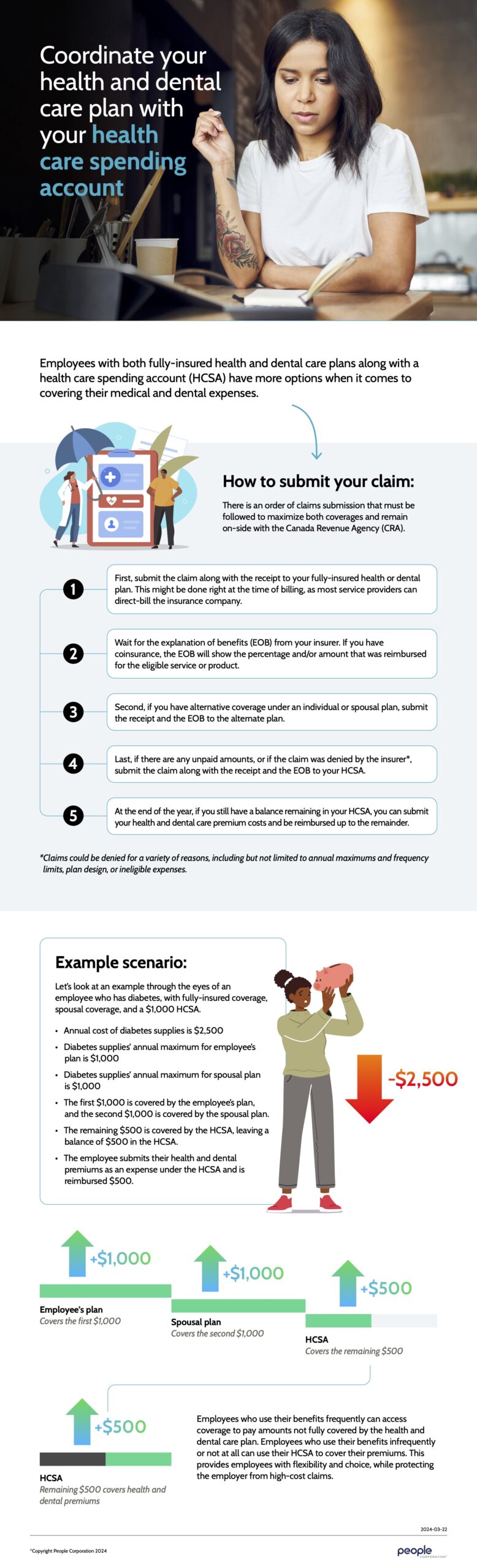
Coordinating your Health Care Spending Account (HSA or HCSA)

We have more and more clients using HealthCare Spending Accounts (HSA or HCSA) each year.  This is a valuable benefit which has lower administrative costs than traditional benefits, and provides great flexibility to employees and their families.

In order to ensure your employees HSA is best utilized, it makes sense to coordinate usage with spousal benefit plans.  (If you are single, or don’t have spousal benefits, you can ignore this post).  The document below provides a simple example of how this process works.  Depending on the provider (insurer or TPA) you use, claims may be handled in slightly different manners, but the general order of operations shown below apply.

If you’re interested in adding an HSA to your plan, or have one and would like to increase your HSA annual limit, let us know and we can make it happen.  Most plans work on the calendar year, so there is lots of time to discuss before make changes for 2025.  Starting an HSA can be done at almost any time.


A 5-Step Guide On How To Legally Terminate An Employee

I think this is a pretty great and quick read about how to do handle termination correctly and items to keep in mind.

If you’re a Mainstay client, we have HR resources to help you with templates, policy and handbook samples etc. Our new HR ON CALL offering (paid by us) is even more timely and can be used to schedule a call for things like this.

Reach out if you’re not already signed up.

HR Resources


With employers across the country terminating employees en masse, it is important to understand how to approach terminations in a lawful way. This article sets out a five-step guide that any employer or human resource professional can follow when broaching the topic of termination.

  1. Identify the “Why”
  2. Understand Your Severance Obligations
  3. Prepare Termination Documents
  4. Conduct the Termination Meeting
  5. Issue Payments and the Record of Employment

https://www.mondaq.com/canada/employee-rights-labour-relations/1442378/a-5-step-guide-on-how-to-legally-terminate-an-employee

MAINSTAY CLIENTS – Free HR just got better with HR on Call

Good Morning,

I’m excited to let you know that we’ve expanded our free HR offering.  

In addition to access to the HR Toolkit for Small Business – an online self-serve HR portal – we’re now offering an HR on Call service as a pilot over the next 2 months at which time we will assess uptake.

And we’re picking up the tab! It’s completely free for all Mainstay clients.

We recognize that while a DIY HR solution provides value, you sometimes need to get your questions answered by a professional HR Advisor.  

  • The HR on Call program will launch Monday March 18 and will be available between 9:00AM and 3:00PM EST.
  • You’ll need to sign up for the HR Toolkit to get access to HR on Call.

Click here to find out more and sign up.

We are continuously working to add value to our clients and hope you’ll take advantage of this exclusive offer. 

If you have any questions at all, please let me know and I would be happy to help.

Dave

Working to improve the industry

I am asked to share my industry knowledge with; industry think tanks, insurers and TPA’s, associations, and advocacy groups throughout the year.  We are involved in, and share, through surveys, panels, advisory boards, helping write (or participate in) articles and research by dozens of organizations each year.

We participate in order to give back and try to make the industry better for our clients, but also for other stakeholders.  They come from across the country, and can include; patient groups, insurers, TPA’s, advisors and others that are in the benefits marketplace.  This is a great way for advisors to learn from others across the country, and with those that work with different size clients and varying industry sectors.

This recent event (featured below) had several great presenters sharing useful information with those in attendance.  In return, we shared what we encounter with clients, feedback about programs and sometimes discussions around the lack of solutions.  

The article below was featured in HR Reporter magazine.


MAPOL AND H3 CONSULTING co-hosted a meeting with 12 leading benefit advisors from across Canada, who collectively manage life and health plans for hundreds of employers. The event was sponsored by five pharmaceutical manufacturers. The purpose of the meeting was to exchange information and ideas on how plan members experience their benefit plans in three key areas – fertility, vaccines, and the effects of drug-claim pooling on access to high-cost drugs. National pharmacare was also discussed, given its potential to disrupt drug benefits in the mid-term. All topics generated significant and insightful discussion.

https://premium.hrreporter.com/ca-2024-exclusivefeature-considering-the-plan-member-experience/p/1